'Wait, you don't have a semantic layer yet?' AI analytics readiness pulse
有效阅读仅保存在当前浏览器,用于「为你」推荐;暂停或清除记录。
DataHot 速览
TL;DR We built an AI analytics readiness quiz to help people find the right session during AI Analytics Week. 73 people took it ahead of the sessions. Then we polled the rooms, and this is what we learned. This is not an industry benchmark — it’s a small sample, selection bias aplenty, and responses
本文目录 8 节
原文
TL;DR
- We built an AI analytics readiness quiz to help people find the right session during AI Analytics Week. 73 people took it ahead of the sessions. Then we polled the rooms, and this is what we learned. This is not an industry benchmark — it’s a small sample, selection bias aplenty, and responses are anonymous — but in the interest of sharing, this is an honest take on what we learned. Let’s call it a vibe check.
- Over half of respondents are using AI with their data regularly or running a pilot program. Another 22% haven’t started, and most of those said the reason is they don’t know what’s available in the tools they already have.
- People want control over where AI runs — 44% said everything has to stay on their own servers, 14% need to bring their own model — and that demand is strongest among the people who haven’t started yet.
- AI anxiety is fairly low. No one’s worried about how it impacts their jobs. Concern creeps in around governance, but it’s not a blocker. Two-thirds of the people who said AI keeps them up at night want to hand agents a direct line to their data anyway.
- Half of everyone who took the quiz wants to work with their data through AI agents over MCP. Among people already using AI regularly, it’s 78%.
- And the surprising one: 31% of the people who answered said they don’t know what a semantic layer is (spoiler: the foundation for trustworthy AI answers).
We held AI Analytics Week in August as a series of webinars, aiming to make AI analytics more approachable for teams who haven’t enabled it yet, a clear starting point for those who are ready, and frameworks for scaling it with governance for those who are already running (you can catch all of the sessions on demand, and more here). We also wanted to take the opportunity to get a vibe check on how people are feeling about it, where you’re at with implementation, what gives you pause, what makes you really excited.
The AI readiness quiz was a way to match people to a session that meets them where they’re at with AI analytics, by asking five things: where you are with AI today, what’s in the way, how much control you need over where it runs, how you want to build, and how you feel about it changing your job.
The common narrative we tend to see floating around AI in analytics is apprehension and more questions raised than answered: can I trust the numbers? How do we protect our warehouse? Is somebody’s role on the line? That’s not really what this pulse reflected. What came back was a lot of curiosity, a short list of practical blockers, people already running AI on data they haven’t tidied up yet, and excited to optimize.
What we asked, and who answered
AI Analytics Week was a series of three live webinar sessions:
- AI analytics, with receipts — for setting up a trustworthy foundation for asking questions in natural language and verifying the results.
- AI analytics on your terms, and your infrastructure — for setting up AI analytics under the strictest security, sovereignty, and regulatory requirements.
- AI analytics with a build button — for managing analytics-as-code with git-backed workflows, building with agents, and a first look at our Data Apps feature.
The quiz was a snappy 5 question deal. It’s anonymous by design — no company, no size, no industry, no email — so we can’t cut these numbers by firmographics. This is a small, self-selected sample of people who opted into a quiz about AI analytics readiness during a week of Metabase programming about AI analytics. It skews technical. It skews toward people who already like us. It is deeply unscientific, but we thought the results were interesting enough to share.
We also polled the rooms during the three live sessions — 70 people voted in at least one poll across the week. Those polls were optional, and participation varied: some people voted in none, some in one or two, some in every question. So every poll number below is a share of the people who voted on that question, not of everyone in the room. Those denominators run from 12 to 34.
Where teams are at with AI analytics
The quiz opened with the obvious question: where’s your team with AI in your analytics today?
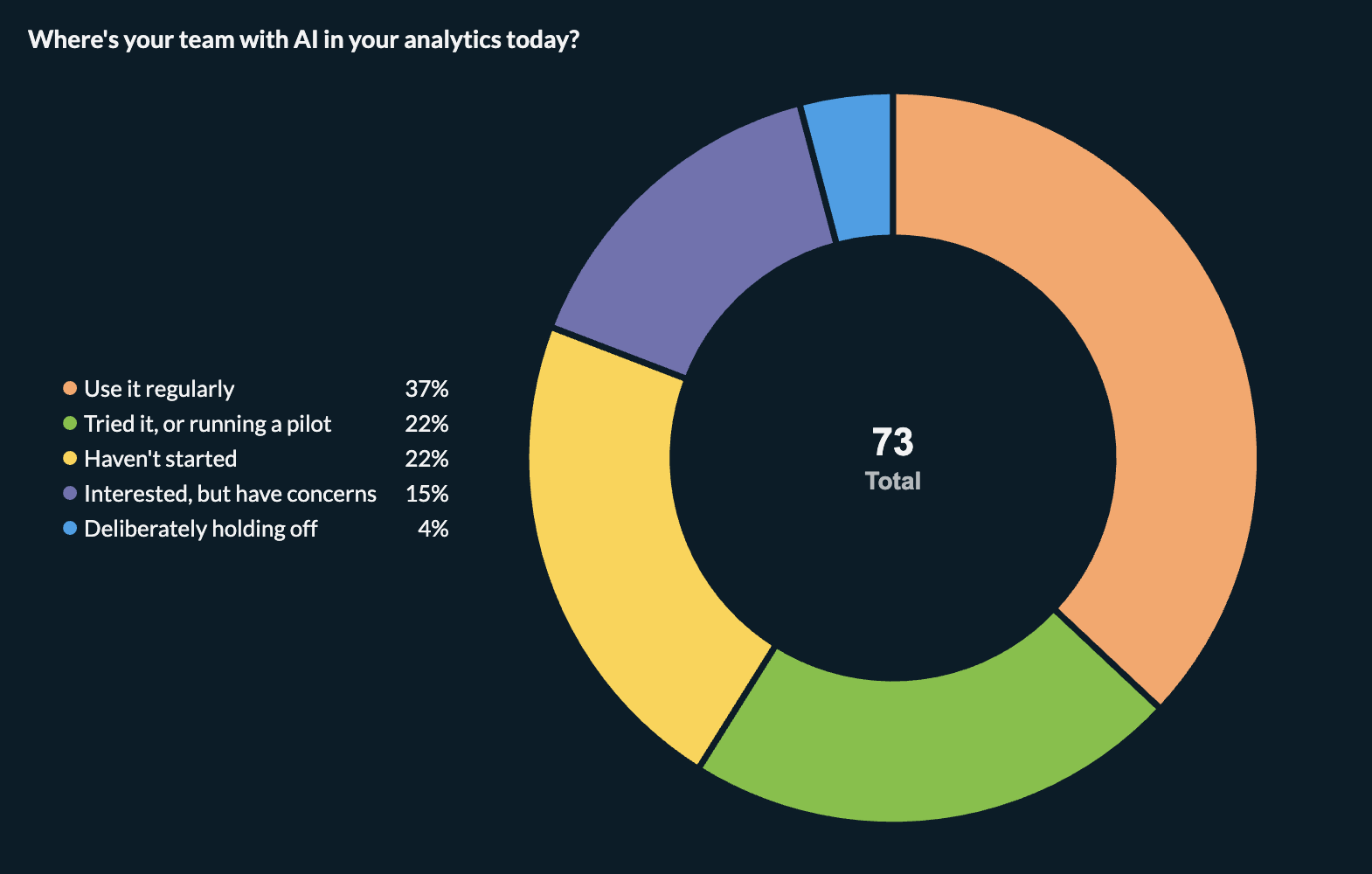
So 59% are past the starting line, and only 4% have decided against it. The 22% who haven’t started are the group we built the “receipts” session for, and it’s worth looking at why they haven’t.
The in-session poll asked a related question — what, if anything, has stopped you from trying Metabase’s AI? Of those who voted, 26% said they’re already using it, 26% said they weren’t sure what was available (a dagger to my product marketer heart - please go back and read all of our release announcements in order, asap), 21% said other, 18% haven’t had time, and 9% said their data isn’t ready. “Weren’t sure what’s available” ties for first. That’ll come up again.
What’s in the way of starting with AI analytics
Asked what’s holding them back, if anything:
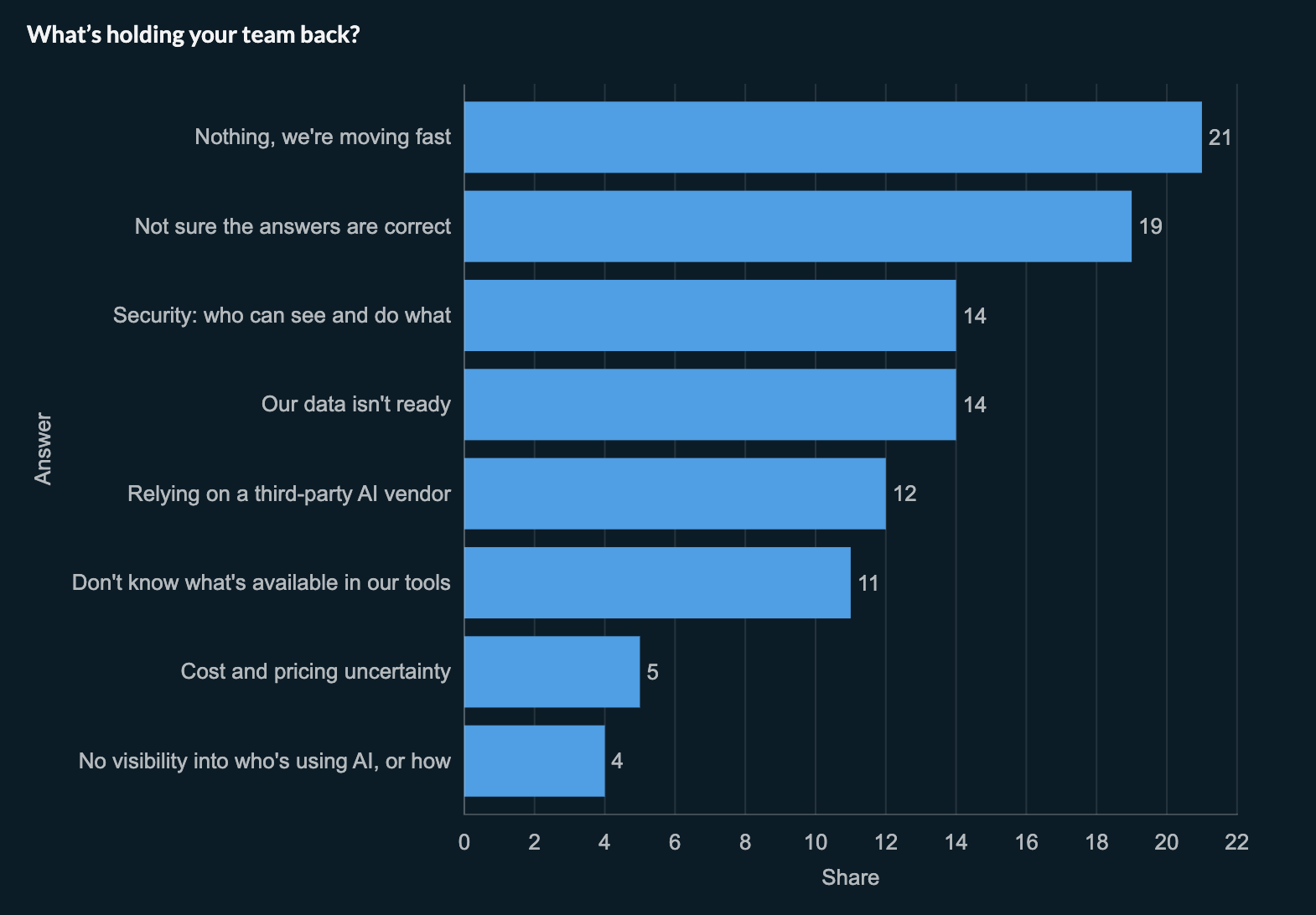
The top answer is “nothing,” which tracks with 59% already using it. Correctness is the top actual blocker, and it’s the one that shows up across everything. Among people using AI regularly it’s still the second most common answer at 22%, right behind “moving fast.”
The session poll on what worries people about AI-generated answers lines up with the correctness number. Of those who voted, 48% said wrong numbers, 37% said they can’t tell how it got the answer, 19% said they’re not worried but curious how to prove it, and 11% said no control over what it can see. (That poll allowed more than one pick, so these are shares of people, not votes.) Wrong numbers and not being able to see the derivation aren’t really two separate worries — you can’t evaluate the first without the second, which is why every Metabot answer shows its query.
That fit our assumption, and it’s why we decided to anchor the first session on how to curate your semantic layer in Data Studio to form a verified foundation for your AI to pull answers from, and why to do it inside Metabase.
How much control teams want over AI analytics
This is the question we built the “on your terms” session around, and the answers were more decisive than we expected.
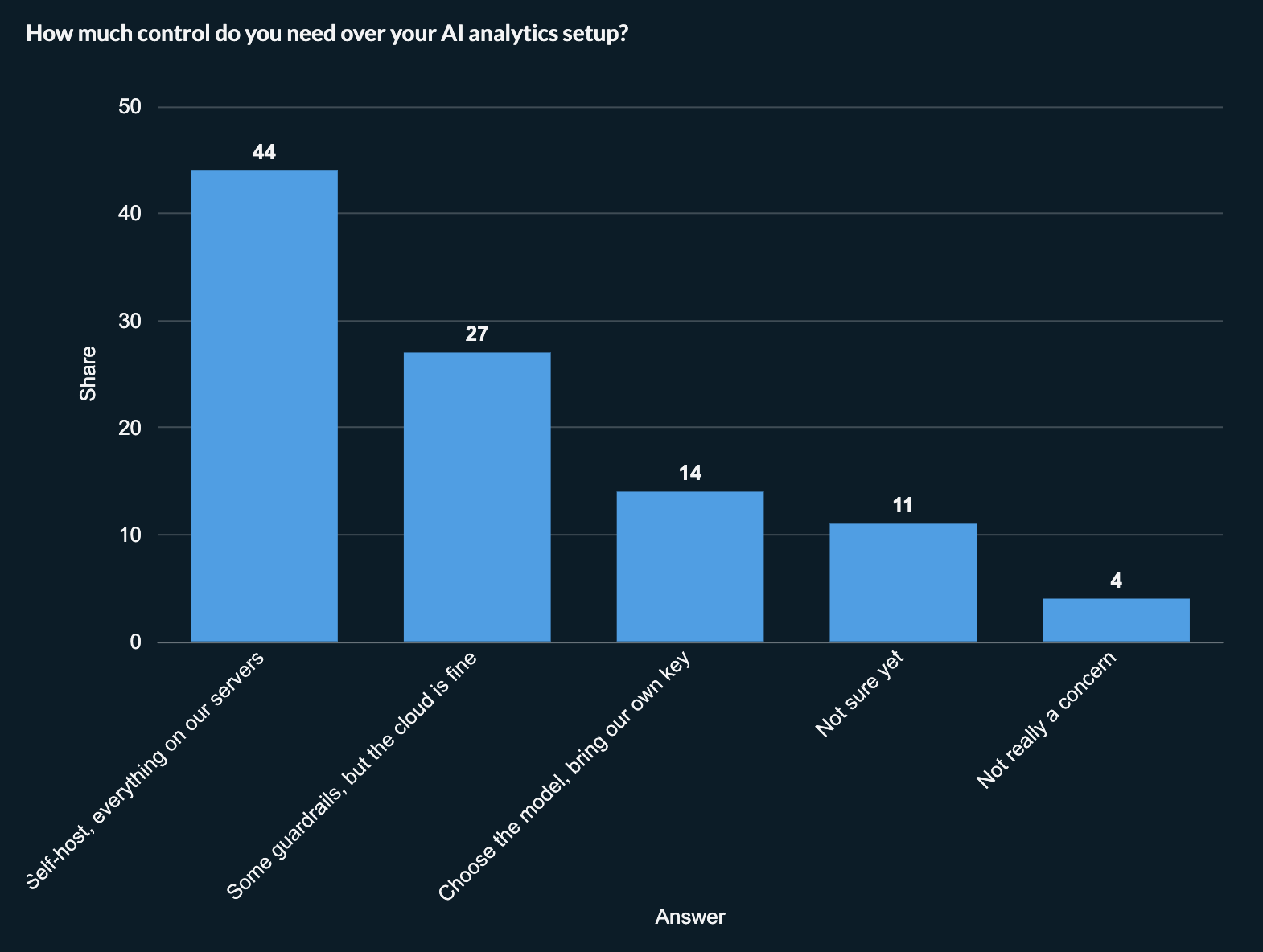
58% want to self-host or bring their own model. The in-session sovereignty poll landed on the same number from a different direction: 58% of those who voted said they can’t have data leave their network, 21% need to be HIPAA, BAA, or ISO 27001 compliant, 16% weren’t sure yet, 5% have data residency requirements, and nobody picked “not a huge concern.” Two different questions, put to overlapping audiences, landing in the same place. The quiz is anonymous, so we can’t say how much the two groups overlap — only that the answer didn’t move when the question changed.
The interesting cut is by experience. Split the self-hosting answer by how far along people are:
| Where they are with AI analytics | Want everything self-hosted |
|---|---|
| Haven’t started (16 people) | 69% |
| Tried it, or running a pilot (16) | 38% |
| Using it regularly (27) | 30% |
Control demand runs inverse to experience. The people who haven’t started are the ones most insistent that nothing leaves the building; the people using AI every day have mostly made their peace with a cloud that has guardrails. We can’t tell you why from this data — it might be that the teams with the strictest requirements are the ones who haven’t found a deployment that meets them yet, or that unfamiliarity breeds maximal caution, or both.
A couple of things from the polls worth putting alongside that. Bring-your-own-model came out as a hard requirement for 27% of voters and preferred for 55%; only 9% said it doesn’t matter. And of the people who said data can’t leave their network, every one also voted on BYOM, and none of them picked “doesn’t matter” — those read as one requirement, not two. Asked which AI governance concern matters most, the top answer was “what it can see” at 44%, then how much it costs at 22%, where the model runs at 15%, who can use it at 11%, and audit trail at 7%.
This fits a broader trend we’re seeing with more teams treating data sovereignty as a starting point for the conversation around AI analytics, especially for those in regulated industries and security-conscious orgs who need to ensure no data ever leaves their network. AI didn’t create this need, but keeping everything on your own infrastructure, having tight control, oversight, and auditability over who and what touches your data, has become more urgent with autonomous agents joining the chat.
On industry: half the people who voted said they’re not in a regulated industry, 29% said other regulated, 14% healthcare, 7% financial services. Fourteen people, so hold it loosely. Being unregulated didn’t make anyone noticeably more relaxed, for what that’s worth at that sample size.
How people want to build with data and AI
Asked how they want to work with their data and analytics:
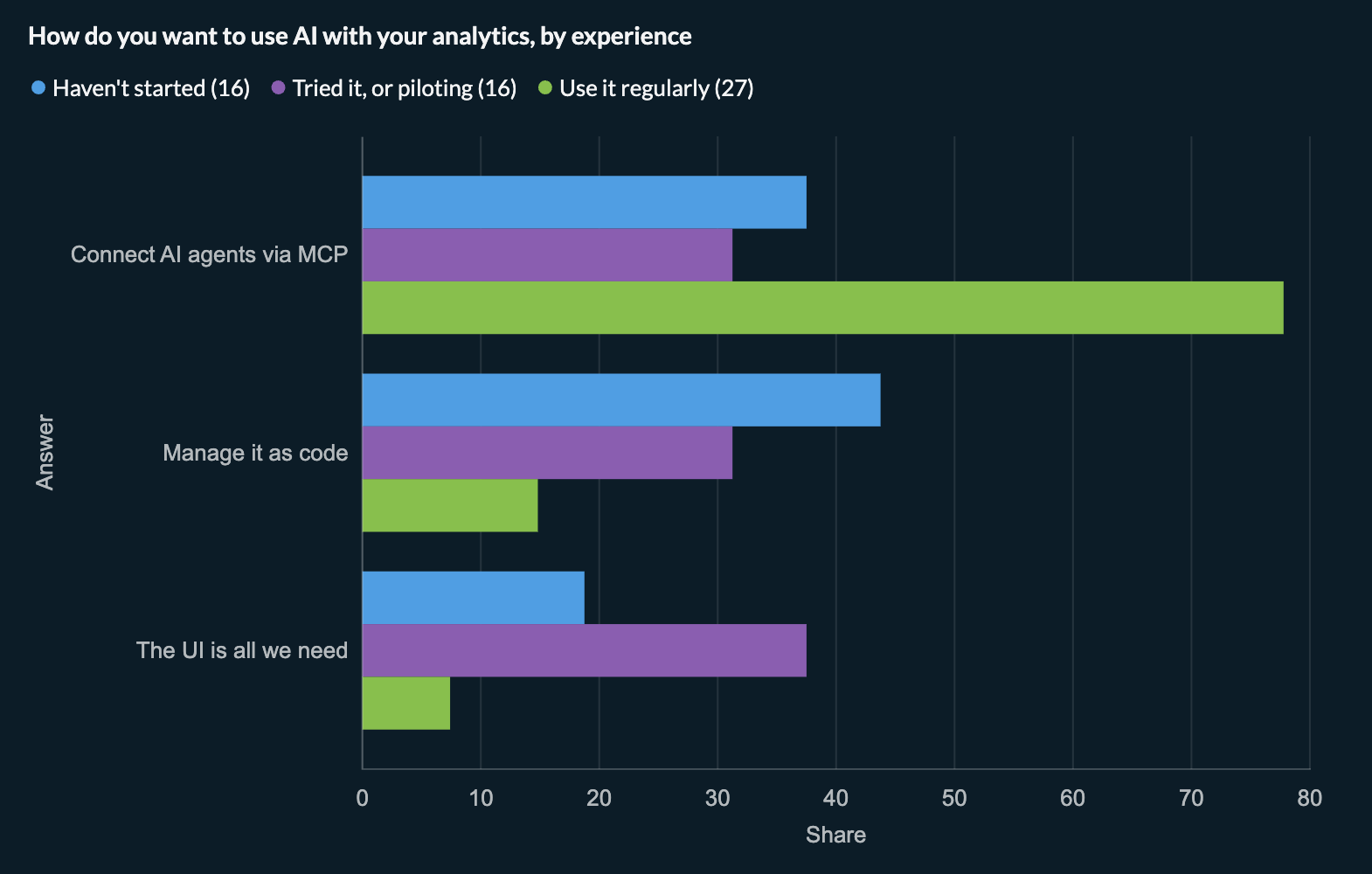
Half of everyone wants agents. Among people already using AI regularly, it’s 78%. Among people who haven’t started, it’s a near three-way split between code, MCP, and the UI.
We can’t tell you which way that runs — whether working with AI regularly pushes people toward agents, or whether the people who already think in agents are the ones who adopted fastest. In a self-selected sample of 73, both readings survive. What we can say is that the agent preference isn’t there at the start and it’s overwhelming by the time people are using AI daily.
The “build button” session polled on the same theme. 53% of those who voted had already connected an AI coding tool to Metabase, 13% to something else, and 33% said not yet but they want to. On who should own dashboards if they’re code now: 58% said analysts, 25% said both, 8% engineers, 8% nobody’s volunteering. And on what’s most painful about managing dashboards today: 50% said duplicating a dashboard across environments, 33% said changes go live with no review step, 8% out of sync between environments, 8% nothing major. Twelve voters on those last two, so read them as a mood rather than a measurement.
How people feel about AI analytics
The last quiz question was the human one: how do you feel about AI changing your, or your team’s, role?
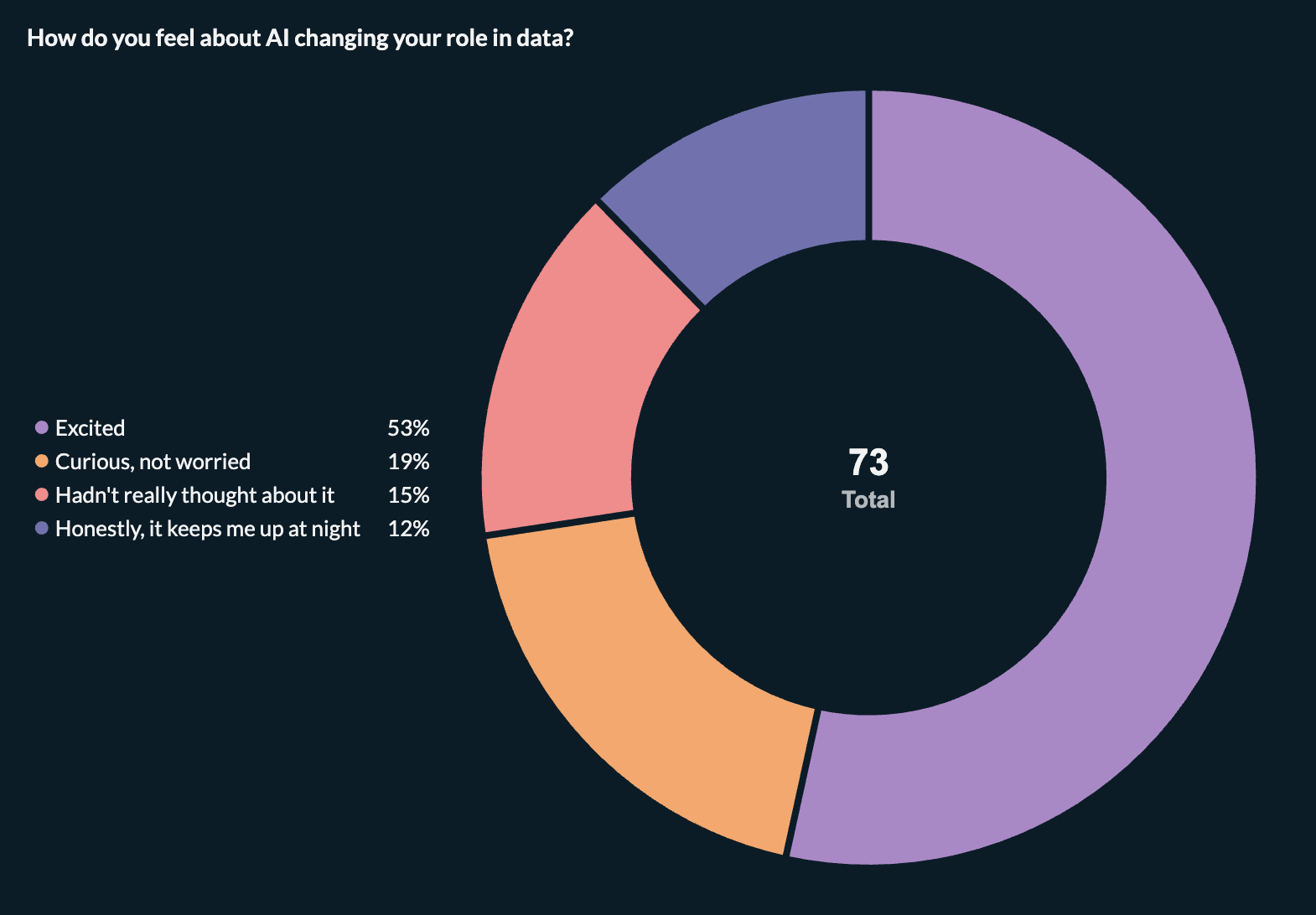
Most respondents are somewhere between curious and excited. One in eight is losing sleep. The worry concentrates in the group who described themselves as interested but concerned about access, security, or sovereignty, where 27% said it keeps them up at night. And of everyone who picked that answer, two-thirds want to connect agents to their data over MCP anyway.
Two other cuts, for the record: the people who want to self-host were the most upbeat group in the sample at 72% excited, with one person out of 32 worried. And the people who want to manage analytics as code were close behind at 71% excited, one worried out of 21.
The semantic layer gap
A semantic layer is a shared set of models, metrics, and definitions that tells AI which data to trust and what it means.
It’s also the thing 31% of our poll voters said they’d never heard of. Another 54% have something partly built and ad hoc, and only 15% called theirs mature.
That’s more common than it sounds, and it’s not a crisis. Pointing AI at raw tables usually works fine at first, or while your org and your data are still small enough that there’s only one table called accounts. It stops working quietly rather than loudly — once there’s an accounts_v2 and an accounts_final and nothing to tell an agent which one the company actually bills from, the answer still comes back looking just as confident. For AI to work well as you grow, it needs context and guardrails, that’s why we think AI analytics needs a semantic layer before it needs a better model.
In Metabase, you build it in Data Studio, and because we believe everyone should get trustworthy AI answers, the core parts are free and open source. Here’s how to build a semantic layer for AI analytics if you’re starting from zero.
Where to dig deeper
Permissions, data sovereignty, business context, cost controls, and auditability are the things that separate a convincing demo from something you can actually trust putting into production.
Take the quiz yourself to see how your answers stack up, and get resources matched to where you are, from not started to scaling up.
If you were part of the 31%, or not sure if your semantic layer is “mature” or “ad hoc, grab 30 minutes with a product expert. We’ll show you what a semantic layer looks like on your own data.
这篇内容对你有用吗?
反馈只用于改善内容筛选,不等同于收藏