什么是 AIOps?AI 驱动的 IT 运维解析
DataHot 速览
AIOps 将 AI 和机器学习应用于 IT 运维,用于检测异常、关联事件、定位根因并加快响应。文章称 Gartner 于 2017 年提出该词,并解释在 2026 年微服务、多云、AI 负载和 agent 驱动系统带来海量运维信号后,为何重新受到关注。AIOps 位于可观测性与行动之间,补充而非替代可观测性和 DevOps,同时保留人工监督。文章还概括了选型前应评估平台的能力边界。
为什么值得关注:AIOps 与数据/可观测性平台相邻,涉及用 AI 处理海量运维数据、异常检测和根因分析,对运营数据平台或 AI 负载的团队有参考价值。
本文目录 11 节
原文
Artificial Intelligence for IT Operations (AIOps) applies AI and machine learning to IT operations to detect anomalies, correlate events, identify root causes, and trigger responses faster than any manual process can.
Gartner coined the term in 2017. So why are you reading about it now?
Because the infrastructure running your applications in 2026 looks nothing like what traditional monitoring was built for. You are managing hundreds of microservices, multi-cloud dependencies, AI workloads, and agent-driven systems that generate more operational signals in an hour than an on-call engineer can read in a week.
That gap is what AIOps is now positioned to close. This guide explains how it works, where it fits, and what to evaluate before choosing a platform.
- AIOps applies AI and machine learning to IT operations to detect anomalies, correlate events, identify likely root causes, and enable faster incident response.
- AIOps helps teams reduce downtime risk, cut alert fatigue, improve decision speed, and accelerate incident response by turning operational data into actionable insights.
- AIOps complements observability and DevOps rather than replacing them, augmenting AI and platform engineers with operational intelligence while keeping human oversight for higher-risk actions.
What AIOps does and does not do
AIOps analyzes data from logs, traces, events, and network topology to detect issues and predict failures before they surface as incidents.
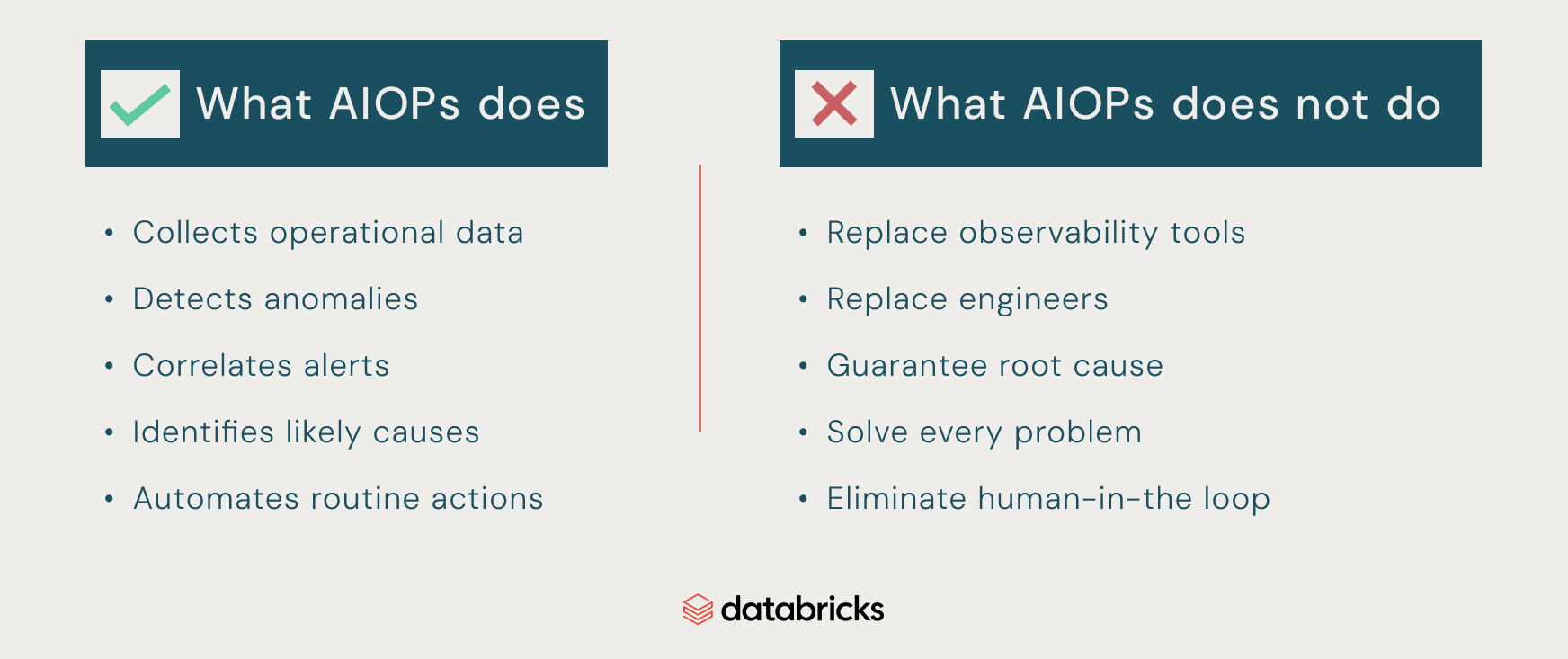
It sits between observability and action. Observability tells what is happening across systems. AIOps takes that signal, reduces the noise, connects related events, and helps platform engineers decide what to do next. It does not replace observability, DevOps, or human judgment. It makes all three faster.
Why now?
As infrastructure becomes more distributed, the volume of operational data, the complexity of dependencies, and the speed of change all increase. Traditional monitoring tools don't meet the growing demands and often generate excessive noise, lacking clear context to prioritize threats. As a result, data teams struggle to identify the signals that matter before incidents affect users.
When teams leverage AI and machine learning in IT operations, they optimize to:
- Reduce downtime risk: AIOps can detect anomalies and correlate related events to identify potential failures earlier, helping resolve issues before they disrupt major services and cause downtime.
- Cut alert fatigue: Machine learning can filter out repetitive or low-value alerts and surface events more likely to require human attention.
- Improve decision speed: By adding context to operational events and identifying likely root causes, AIOps helps engineers determine what is happening and what to investigate next.
- Accelerate incident response: When the appropriate remediation is known, AIOps can recommend or automate actions such as restarting services, scaling resources, or triggering predefined workflows.
These factors specifically lean towards earlier threat detection and faster recovery. They are not meant to conclude that AIOps solves all automation bottlenecks or removes the need for engineers.
What are the core components of AIOps?
While evaluating an AIOps platform, it's important to understand the main building blocks and how they work in their domains:
- Data ingestion: Here, AIOps platforms collect and consolidate data from metrics, logs, traces, events, and alerts from infrastructure, applications, and network devices into a data lake, data warehouse, or lakehouse. Broad and reliable data ingestion gives AIOps the visibility it needs to detect issues across IT environments.
- Data normalization and enrichment: After AIOps collects data from various sources, analytics processes the raw data to highlight trends, predict environments' capacity needs, and detect unusual system behavior before it causes disruptions. This gives downstream analytics a consistent view of what is happening and where it matters.
- Anomaly detection. To detect unusual activity in systems, traditional methods rely on static thresholds, CPU limits, and similar measures to trigger alerts. No context whatsoever. AIOps learns what normal behavior looks like for each metric, by hour, day, and season. Then, it only alerts when that behavior deviates from the baseline. This gives AI engineers more time to investigate potential problems before they affect users.
- Event correlation. When 10 different servers show high CPU usage, AIOps connects the related alerts rather than treating each alert as an isolated incident. This reduces alert fatigue and helps focus on the underlying issue rather than hundreds of individual events.
- Root cause analysis. The old method, where 70 alerts go off and you follow each one, is unsustainable. AIOps understands system topology, examines dependent services during alerts, and surfaces the root cause of the problem. From the alerts, AIOps determines that service C is degraded, while services A and B are only downstream. This accelerates troubleshooting, minimizes business downtime, and saves time by avoiding per-incident investigation.
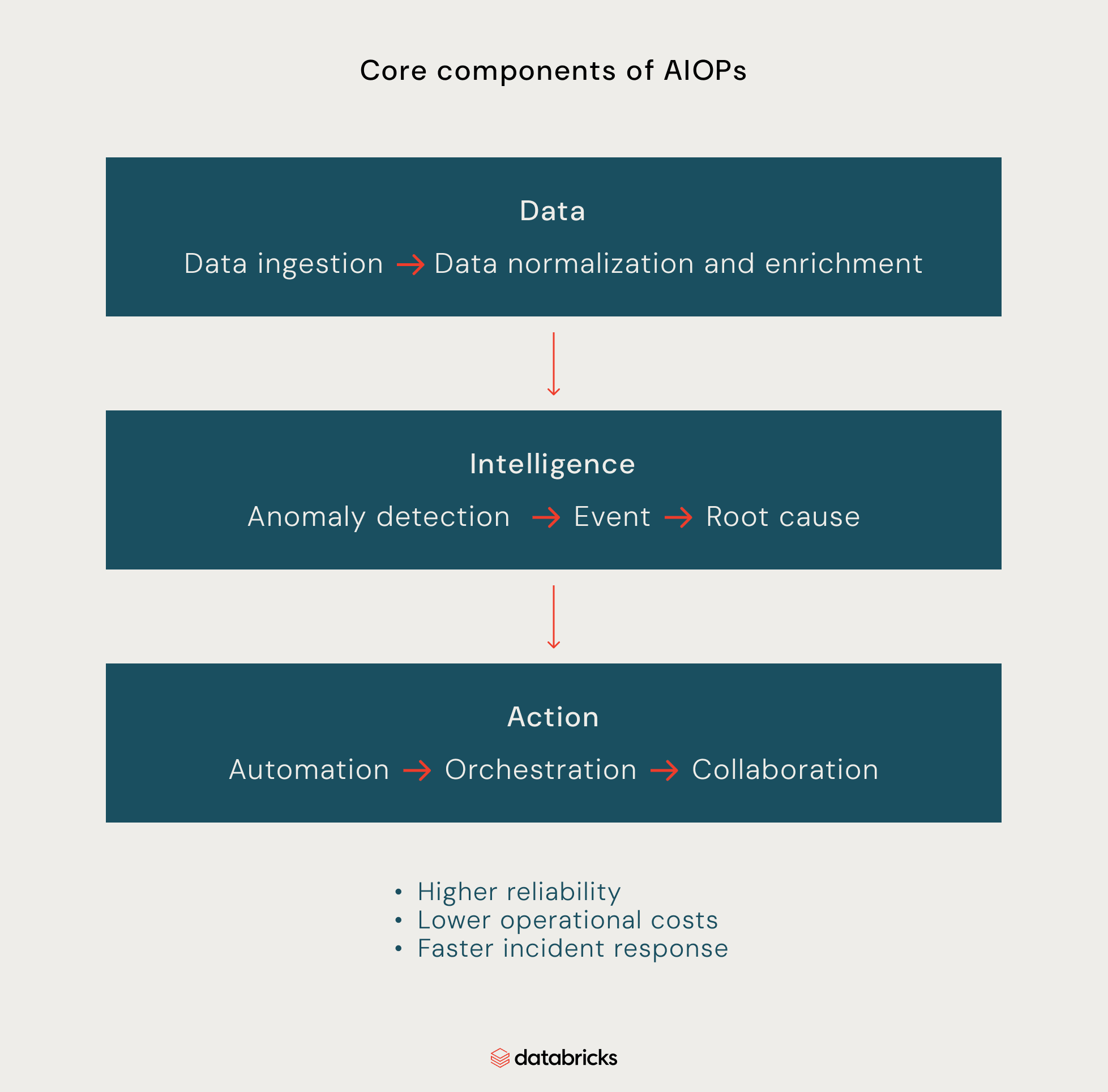
- Automation and orchestration. Once a root cause is identified, AIOps turns these insights into action by recommending or executing predefined responses, such as restarting a service, scaling infrastructure, rolling back a deployment, or opening a ticket. This component reduces manual intervention, accelerates incident resolution, and helps control operational costs. For more advanced operational workflows, Agent Bricks can help teams build and deploy AI agents that use enterprise data and tools to perform multi-step tasks.
- Collaboration workflows. Connects AIOps insights to the people and processes responsible for resolving incidents. This can include routing alerts, assigning ownership, escalating incidents, and providing engineers with the context they need to respond.
With these core components, let's see how they come together in the following section.
How does AIOps work?
The AIOps process starts with collecting signals from applications, infrastructure, networks, and cloud services. The data then undergoes cleanup, in which duplicate, incomplete, or inconsistent signals are organized into a format that AIOps can analyze.
For instance, your system detects that your application suddenly starts returning a high number of Application Programming Interface (API) errors. AIOps compares your application's current behavior with previous patterns and flags an increase in errors as unusual.
With event correlation, the AIOps platform connects the API errors to other signals, such as a sudden increase in database load or a recent deployment. Likely-cause analysis then examines these connected signals to determine probable causes. Instead of treating the API errors, database load, and deployment as separate events, AIOps identifies the recent deployment as the likely source of the incident.
The final stage is guided or automated response. Depending on the workflow, AIOps can recommend a remediation action, open a ticket, notify the appropriate team, or automatically execute a predefined response such as rolling back the deployment.
Higher-risk actions should require human-in-the-loop to allow engineers to review and approve the response before it affects production.
What are the main types of AIOps?
The types of AIOps depend on what best fits the organization, the scope of its operations, the systems to manage, and the level of interconnection in infrastructure.
Domain-centric and domain-agnostic approaches are the two main types of AIOps. Neither is a direct substitute for the other; they have their strengths and trade-offs:
Domain-centric AIOps focuses on a specific area, such as cloud management, network performance, or application monitoring. A domain-centric approach is a go-to for troubleshooting issues with a specific domain; it provides deeper context and more specialized analysis within that environment.
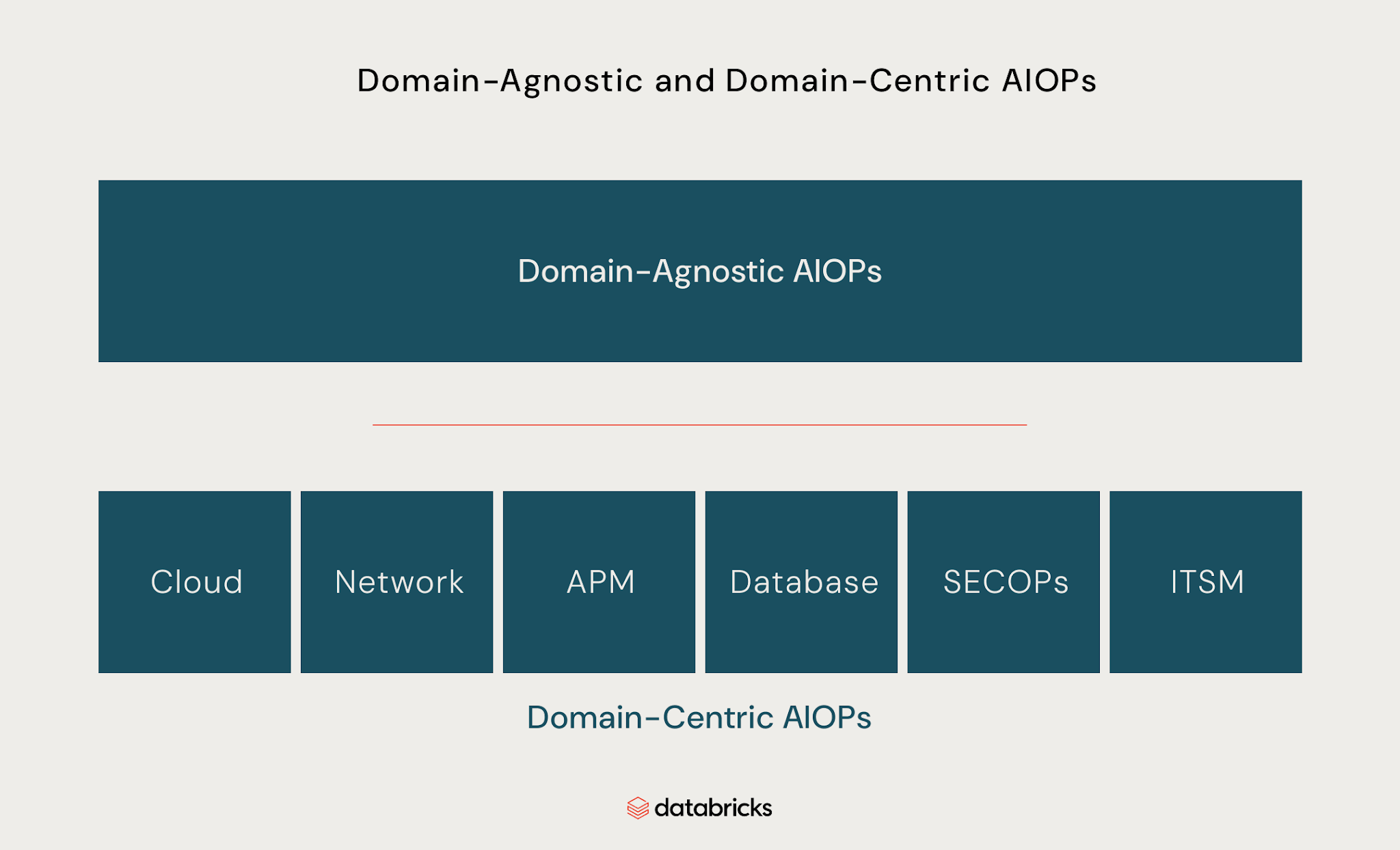
Domain-agnostic AIOps operates across multiple IT environments, collecting and analyzing data from systems such as applications, networks, cloud infrastructure, and storage. In contrast to the domain-centric approach, domain-agnostic AIOps platforms are best suited to solving broader issues. This makes it more suitable for organizations managing complex, interconnected infrastructure where incidents often cross operational boundaries.
Domain-centric AIOps can provide greater depth and more specialized intelligence within a single domain, while domain-agnostic AIOps provides greater breadth and broader visibility across systems and tools.
Common AIOps use cases
AIOps use cases span many areas of IT operations; some of the most common applications include:
Root cause analysis
AIOps helps pinpoint the likely cause of an outage, error, or performance issue. Instead of treating a spike in API errors as an isolated incident, AIOps can correlate it with a recent deployment, a database failure, or a network configuration change.
Anomaly detection
AIOps continuously scans system data to establish a baseline and detect deviations that might lead to incidents and failures.
Performance monitoring
AIOps can monitor IT environments across cloud, on-premises, and hybrid environments with interconnected services and dependencies. This helps to identify trends and prioritize issues through constant monitoring and performance correlation.
Cloud adoption and migration
Cloud migrations introduce new dependencies across workloads, APIs, services, and infrastructure. AIOps maps these relationships, monitors changes in system behavior, and identifies potential bottlenecks before they disrupt critical services. AIOps provides clearer visibility into hybrid and multicloud environments during migration.
DevOps adoption
DevOps increases the speed of development and deployment, but also introduces operational risks and issues that can go undetected by humans. AIOps monitors deployment activity, analyzes its impact on production, and can trigger predefined responses when issues occur.
AIOps and DevOps address different parts of the software delivery and operations lifecycle and are more effective when integrated.
这篇内容对你有用吗?
反馈只用于改善内容筛选,不等同于收藏