返回
RSS Databricks Blog 原文 · 未翻译 发布 2026-09-01 21:30 收录于 09-02

Discovery Bank用行为AI与治理数据实现规模化超个性化

DataHot 速览

Discovery Bank将银行架构建立在基于行为科学和AI的数据产品之上,通过可复用决策逻辑在营销、数字体验、服务等场景保持一致,并借助治理机制支持从洞察到行动的闭环。该案例展示了在满足金融业速度、安全与合规要求的同时,实现超个性化客户体验的路径。文中强调与Databricks合作建设这一数据基础设施。

为什么值得关注:该案例展示了如何通过可复用数据产品与治理机制支撑规模化个性化和实时决策,对数据平台建设者具有直接参考价值。

本文目录 8 节
  1. Build the bank around a shared value
  2. Turn behavioral data into reusable products
  3. Make the next-best action useful to the client
  4. Use behavioral context to protect clients
  5. Layer generative AI on trusted foundations
  6. Improve human-assisted service
  7. Put agents inside governed workflows
  8. From behavioral intelligence to governed action

原文

How can a bank make every client interaction feel personal while meeting the scale, speed, security, and governance expectations of financial services?

Hyper-personalization in banking is the ability to make every client interaction relevant to that specific person, at that moment, based on their actual behavior rather than a demographic segment. It is the difference between sending a savings prompt to every client under 35 and surfacing a specific suggestion to a client who just received a salary payment, has a maturing fixed deposit, and has browsed the investment section of the app three times this week. At the scale financial institutions operate, this requires governed AI infrastructure, not manual configuration.

A client’s relationship with a bank generates a continuous stream of signals—from payments and spending patterns to savings behavior, digital engagement, borrowing decisions, and service conversations. The challenge is turning those signals into useful next steps while keeping personalization, fraud protection, servicing, and governance connected.

For Discovery Bank, launched in 2019 to transform banking in South Africa, the answer has not been a single model or application. It has been to build the bank around data products based on behavioral science and AI, then embed those products across the business. This foundation supports financial wellness, personalized journeys, fraud protection, banker assistance, generative AI, and controlled actions through agents. For the teams building these capabilities, reusable decisioning keeps definitions and controls consistent across marketing, digital experiences, servicing, and behavioral-change initiatives.

Discovery Bank’s experience offers a practical lesson for financial services leaders. AI becomes more valuable when it is connected to:

  • Trusted data
  • Reusable analytical products
  • Deterministic services
  • Governance that remains present as systems move from insight to action

Watch Discovery Bank's Head of Data, Stuart Emslie, share how they partnered with Databricks to achieve this.

Build the bank around a shared value

Discovery Bank applies Discovery Group's core purpose—to make people healthier and to enhance and protect their lives—to financial behavior through its shared‑value banking model. When clients improve their financial behavior, they can save more, manage credit more effectively, and become more financially resilient. That creates value for the client, reduces risk for the bank, and contributes to a more resilient society.

Delivering on this model requires a detailed and continuously evolving understanding of each client’s behavior. Clients have different spending profiles, financial goals, and ways of thinking about financial health. That is why Discovery Bank made data, actuarial science, behavioral science, and AI foundational to the bank.

Turn behavioral data into reusable products

Discovery Bank brings together demographic data, transactional and spending behavior, digital engagement, savings and borrowing indicators, credit risk signals, rewards participation, and lifestyle-related information.

Discovery Bank uses the Databricks Data and AI Platform to unify this information under one governed platform and create reusable data products, including engineered features, behavioral indicators, model scores, trends, forecasts, and recommendations. Discovery Bank’s data science engine combines predictive and regression models, quantile regression, advanced segmentation, and similarity searches to create evolving profiles of client behavior.

These governed, reusable data products support acquisition and pricing, risk management, product and experience personalization, service improvement, banker enablement, unusual-activity detection, and fraud protection. The same underlying intelligence can create value across domains while applying the permissions and controls required for each use case.

This approach also improves the way teams work. Rather than creating separate versions of client intelligence for every application, practitioners can build on shared, governed assets. Delta Lake, MLflow, and Unity Catalog support the data, modeling, and governance patterns needed to operate those assets as production capabilities.

Make the next-best action useful to the client

One of Discovery Bank’s initial applications was next-best action (NBA). The goal is not to identify something the bank wants to communicate. It is to determine what action is relevant and valuable for a particular client, in a particular context, at a particular point in time.

That distinction changes the role of personalization. A next-best action should support the client’s journey toward financial health, rather than simply increase outbound communication. The same intelligence can drive inbound and outbound interactions, digital journeys, and banker-assisted service.

Discovery Bank's NBA model has produced a 40% uplift in client engagement impact. It has also changed how data teams work: pipeline development runs 20x faster and data product creation is 5x faster, because teams build on shared governed assets rather than starting from scratch for each channel.

For the data, analytics, actuarial, ML, and product teams building these capabilities, the design principle is clear: keep decisioning reusable and separate from the channel where it is activated. A shared decisioning layer can support marketing, digital experiences, servicing, and behavioral-change initiatives while keeping definitions and controls consistent.

Use behavioral context to protect clients

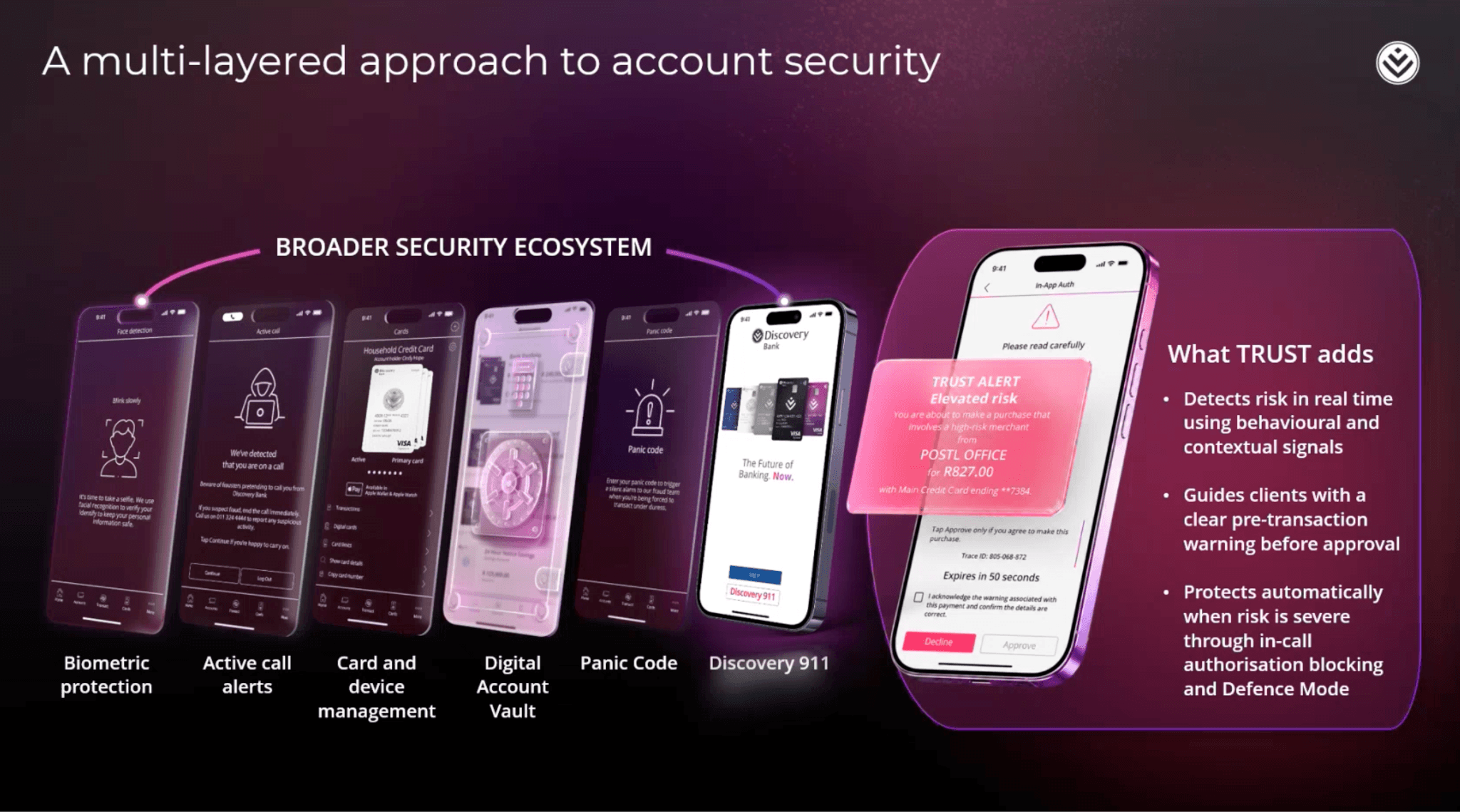
The same intelligence that supports personalization can strengthen security. Traditional fraud controls ask whether a transaction matches a known pattern. Discovery Bank’s TRUST™ alert adds a complementary question: does the transaction make sense for this specific client?

TRUST™ alerts evaluate financial interactions against a client’s behavioral norms and patterns. Discovery Bank has processed hundreds of millions of financial interactions and applied predictive models, clustering, quantile regression, and anomaly detection to quantify how unusual an interaction is.

The result is a risk assessment rather than a binary answer. A moderately risky interaction can trigger an alert that explains why the activity appears unusual and lets the client decide how to proceed. A high-risk interaction can lead to stronger intervention, including locking the client’s account.

This graduated approach balances protection with client experience. It also makes explainability essential: a risk score alone is not enough. Clients and operational teams need context to understand why an interaction was flagged. The models are operationalized through a custom Azure-based serving architecture that returns decisions at scale in less than a few hundred milliseconds.

image2.png

Layer generative AI on trusted foundations

Discovery Bank’s principle for generative AI is that it should not replace foundational data and ML capabilities. It is most powerful when it works with them.

Traditional data products provide trusted context. ML models provide predictions, forecasts, and recommendations. Generative AI can make that intelligence easier to access, explain, and apply.

The architecture described by Discovery Bank brings together four layers:

  • A governed data layer containing curated client, product, and transactional information
  • An analytical layer where models generate forecasts, behavioral insights, recommendations, and next-best actions
  • Control tools and services that expose the information and core functionality needed by the AI experience
  • A generative layer using specialized large language models, processes, and agents to determine the action and response

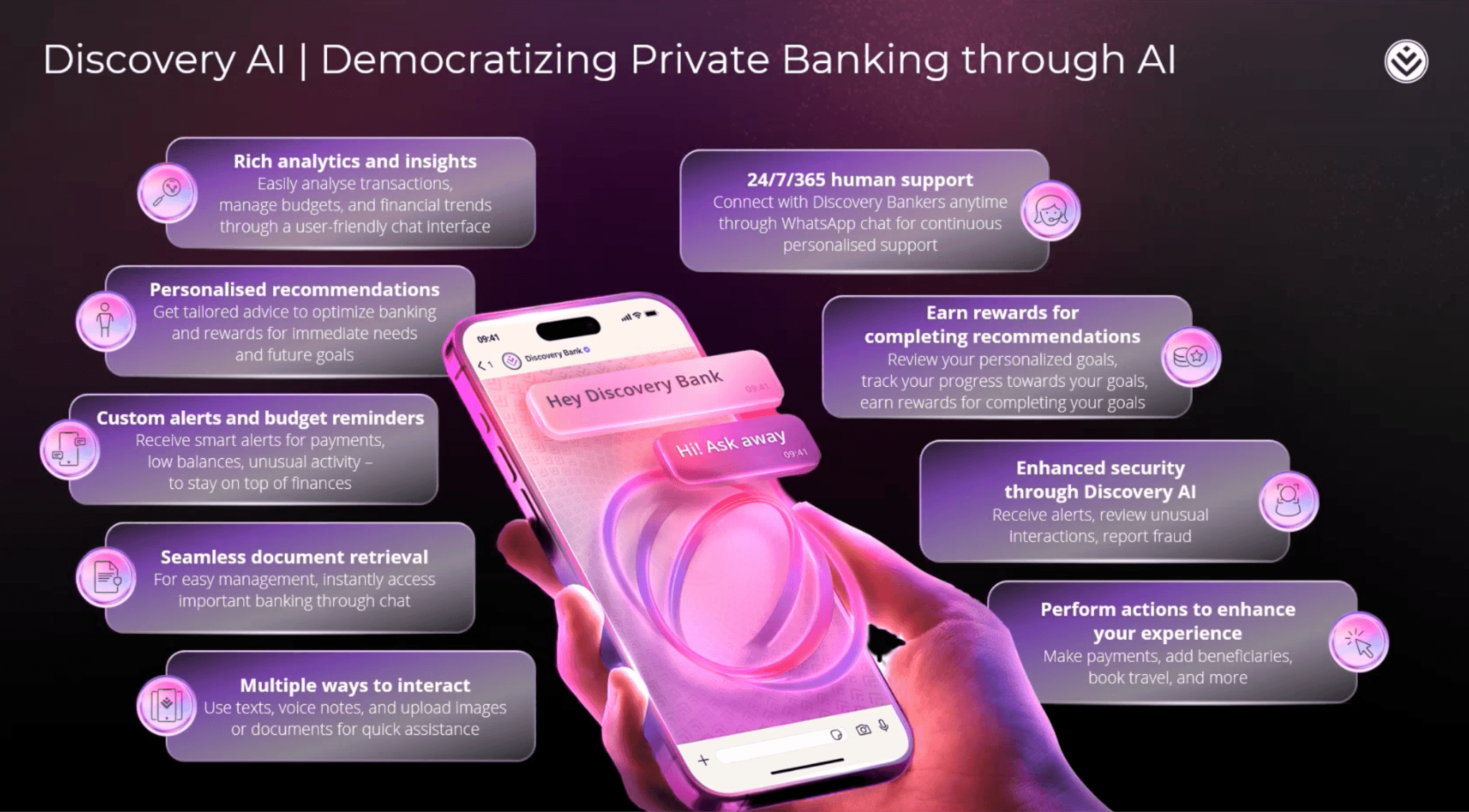
Discovery Bank launched Discovery AI in May 2025 with a vision to democratize private banking. Not by recreating a human private banker with a chat interface, but by changing the servicing experience through deeper actuarial and behavioral intelligence.

Discovery AI can answer servicing questions, help clients navigate banking journeys, analyze aspects of their financial behavior, surface personalized insights, provide recommendations, and assist with selected actions. Instead of finding the right menu or form, a client can describe the outcome they need, and the system can help orchestrate the appropriate journey.

image1.png

Improve human-assisted service

Discovery Bank applies the same intelligence to self-service, text-based banker chats, and in-app calls. For human-assisted service, Discovery Bank also uses a banker-facing AI assistant that retrieves and generates relevant information about the client and the service inquiry. Another capability brings recommendations and next-best actions into the interaction by explaining why each recommendation is relevant and providing supporting information.

AI also helps analyze servicing interactions. Subject to governance, privacy, and quality controls, it can identify recurring client problems, emerging service issues, quality gaps, and opportunities to improve journeys. Broader analysis helps teams track performance trends and coach agents toward better outcomes.

This moves AI beyond operational efficiency. It can improve the quality of the interaction and help the organization learn from a broader set of client conversations.

Put agents inside governed workflows

Discovery Bank’s agentic pattern combines deterministic services, traditional ML models, orchestrated LLM-based processes, and agents. Agents do not replace the control environment; they operate within it.

In agentic use cases, clients can provide text, voice, images, or documents to make payments, complete purchases, or perform related actions. Existing controls remain part of the flow. TRUST™ alerts, for example, continue to evaluate fraud risk, while Unity Catalog provides a consistent governance layer across structured banking data, behavioral features, model outputs, documents, recordings, retrieved content, and information made available to generative applications.

The same principle applies to document-heavy journeys. A multimodal system can classify a document, extract fields, check information against known data, identify inconsistencies, and guide the client on what is required next. In areas such as credit and Vitality Money (Discovery Bank’s reward programme), this can make manual administration a faster, more useful process.

From behavioral intelligence to governed action

Discovery Bank’s data and AI journey has been cumulative. It began with a governed data platform and reusable data products. The bank then built behavioral models and decisioning for personalization and fraud prevention. Generative AI made that intelligence easier for clients and bankers to access, while agents began orchestrating controlled actions and redesigning complex journeys.

Data teams can use direct pipelines and an integrated ML framework, eliminating SQL conversions (the process of changing data from one data type into another) and simplifying code management. Data processing times are 20x faster and data product creation and implementation times are 5x faster. Taking advantage of cross-team collaboration, reduced complexity and high-efficiency gains, Discovery Bank has also increased their model-building capacity to more than 300 models per day.

The Databricks Data and AI Platform has transformed the bank’s ability to build the centralized ecosystem it needs to drive shared value by integrating different components into a single, consolidated platform without dependencies. These efficiencies drove a faster time to insight and time to production, yielding a significant return on investment of more than 500%.

For financial services teams, the practical lessons are straightforward:

  • Build reusable intelligence around business outcomes, with clear ownership and definitions
  • Make actionability explicit: a profile or score should inform a decision, recommendation, intervention, or next step
  • Design explainability into the experience so clients, bankers, and operational teams understand why the system acted
  • Add generative AI and agents to a trusted foundation, keeping deterministic services, ML, permissions, and governance in the loop

Discovery Bank’s experience shows that reusable data products can connect personalization, fraud protection, servicing, and AI across the bank. Start with trusted data, models, controls, and governance, then layer on generative AI and agents to turn insight into safe, useful action.

Ready to learn more? Watch our Financial Services Industry Forum: Financial Intelligence beats General Intelligence to learn how you can operationalize AI at scale.

这篇内容对你有用吗?

反馈只用于改善内容筛选,不等同于收藏

分享这条资讯
分享海报
保存图片
iOS 也可以长按图片保存