13个员工留存策略:留住顶尖人才
DataHot 速览
Visier 发布文章,提出 13 个员工留存策略,帮助企业在 AI 重塑技能需求、工作负荷加重和重组频繁的背景下留住核心人才。文章指出,员工流失会带来招聘、入职和培训成本上升,并导致技能与组织知识流失;Visier 研究显示,37% 的领导者已将流失带来的招聘和培训成本视为劳动力规划不佳的主要后果。企业可通过劳动力数据识别留存风险,并衡量留存措施是否有效。
为什么值得关注:虽然主题是人力资源,但来自 people analytics 厂商 Visier,涉及用劳动力数据识别留存风险,对关注组织人才分析的数据从业者有参考价值。
本文目录 30 节
- Keep your best people, and keep them for longer with these 13 employee retention strategies built for today’s workforce.
- What are employee retention strategies?
- Why do employee retention strategies matter?
- Why are employees leaving in the first place?
- The Employee Retention Blueprint
- 1. Understand: Build the baseline
- 2. Plan: Turn your insights into a retention strategy
- 3. Activate: Make retention happen in day-to-day work
- 13 effective employee retention strategies for retaining your best talent
- 1. Bring the right people on board
- 2. Ensure competitive pay
- 3. Provide great benefits
- 4. Develop managers to lead effectively
- 5. Create and maintain a strong company culture
- 6. Offer flexibility and work-life balance
- 7. (Re)Focus on employee development
- 8. Take the pulse of employee sentiment frequently
- 9. Recognize great work, formally and informally
- 10. Facilitate a respectful and healthy work environment
- 11. Train for AI and be honest about what it changes
- 12. Design onboarding around the first-year risk window
- 13. Plan for ongoing workforce restructuring
- Keep more of the people you can’t afford to lose.
- FAQ: Employee retention strategies
- What are employee retention strategies?
- How can AI improve employee retention strategies?
- Why are employee retention strategies important?
- What causes employees to leave?
- What are the costs of turnover?
- How often should you run stay interviews?
原文
Keep your best people, and keep them for longer with these 13 employee retention strategies built for today’s workforce.
Companies are hiring more selectively and changing how work gets done as AI reshapes the skills they need. For employees, that often means heavier workloads and less certainty about where their role is headed.
The strongest retention strategies help you spot and respond to those risks early, and measure whether your efforts are actually working. The following explore 13 of the best employee retention strategies and how you can implement them.
What are employee retention strategies?
Employee retention strategies are the coordinated policies, management practices, and workforce decisions an organization uses to keep its workers happy and, by extension, reduce its unwanted turnover.
To create one, companies focus on the conditions across the employee lifecycle that shape each person’s decision to stay.
From there, they use workforce data to pinpoint where those conditions are weakening and figure out how to make the work environment more satisfying and equitable. Together, these create the conditions where team members feel compelled to stay long-term.
Why do employee retention strategies matter?
Employee retention needs to be a priority because the costs of losing top talent (and the institutional knowledge they take with them) pose a tremendous threat to every organization.
When experienced employees leave, the effects spread quickly:
- Turnover is expensive. Replacing employees means spending again on recruiting, onboarding, and training. Visier’s own research found that 37% of leaders already see recruitment and training costs from turnover as a major consequence of poor workforce planning, and poor retention exacerbates that.
- You lose skills and institutional knowledge. High performers and long-tenured workers who leave take their expertise and nuanced operational context with them. This in turn stalls immediate productivity and creates capability gaps that aren’t necessarily replaceable even if you hire someone with the same resume skills.
- Teams absorb the disruption. Departures redistribute work and interrupt projects. Remaining employees are the ones who wind up getting stretched while your HR team finds a replacement and brings them up to speed.
- Business performance can suffer. Our workforce planning research also found that 52% of leaders reported lost productivity from skills shortages and mismatches, and 54% cited missed opportunities or delayed projects.
Then you have the downstream benefits of being the type of company that can retain your top talent: it helps you build a strong employer brand and gives future candidates more confidence that they can build a career with you.
To accomplish all of this, you first need an employee retention strategy.
Why are employees leaving in the first place?
Before diving into the specific strategies for retaining employees, it helps to examine the reasons why employees are leaving.
The number one reason is that employees can’t see a compelling future with their current employer. Career-related reasons remained the number-one cause of voluntary departures in Work Institute’s Q2 2026 exit data, accounting for 19.6% of exits.
Other top-mentioned reasons for departure were:
- Management
- Health and family
- Retirement
- Relocation
Those reasons are playing out against a workplace that’s also becoming more volatile. In 2026, 63% of U.S. employees told Gallup they’d recently been asked to take on extra responsibility in the last three months, while 58% had experienced a reorganization or team restructuring in that same recent timeframe.
AI adds an additional layer of uncertainty; employees are trying to understand how their jobs— and the skills needed to do them—will change. Other research from Gallup links the job anxiety stemming from this with greater burnout and a higher overall likelihood of looking for another job.
Visier's own research quantifies that anxiety. In our survey of 1,000 US full-time employees, seven in 10 reported concern about AI's current or potential negative impact on their careers.
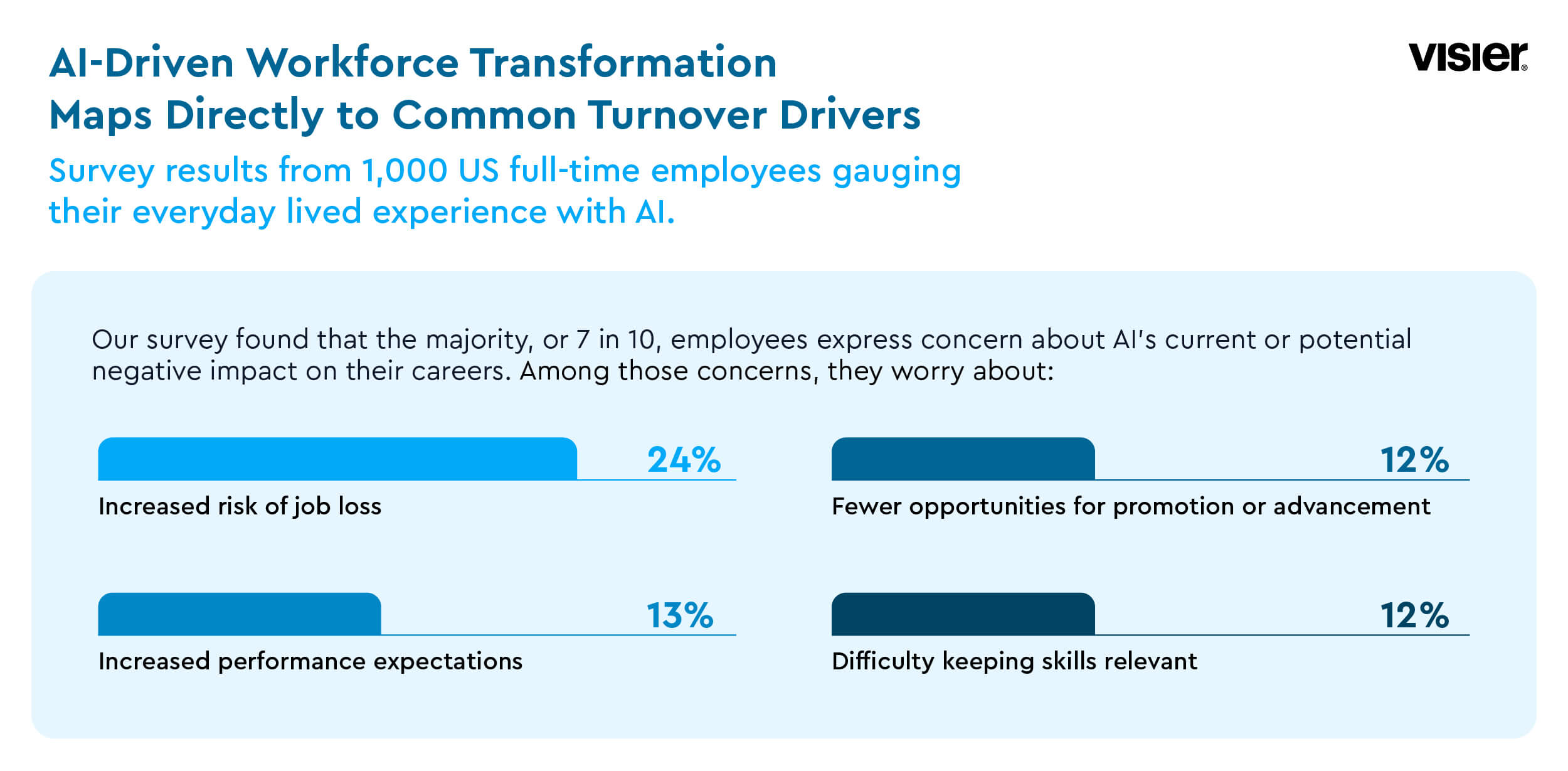
Their top worries map almost directly onto turnover drivers: 24% cited increased risk of job loss, 13% rising performance expectations, and 12% each named fewer opportunities for promotion and difficulty keeping their skills relevant. Those last two describe the same problem: employees just don't see a visible path forward.
A successful employee retention strategy solves the turnover problem by addressing these nuances from multiple perspectives.
The Employee Retention Blueprint
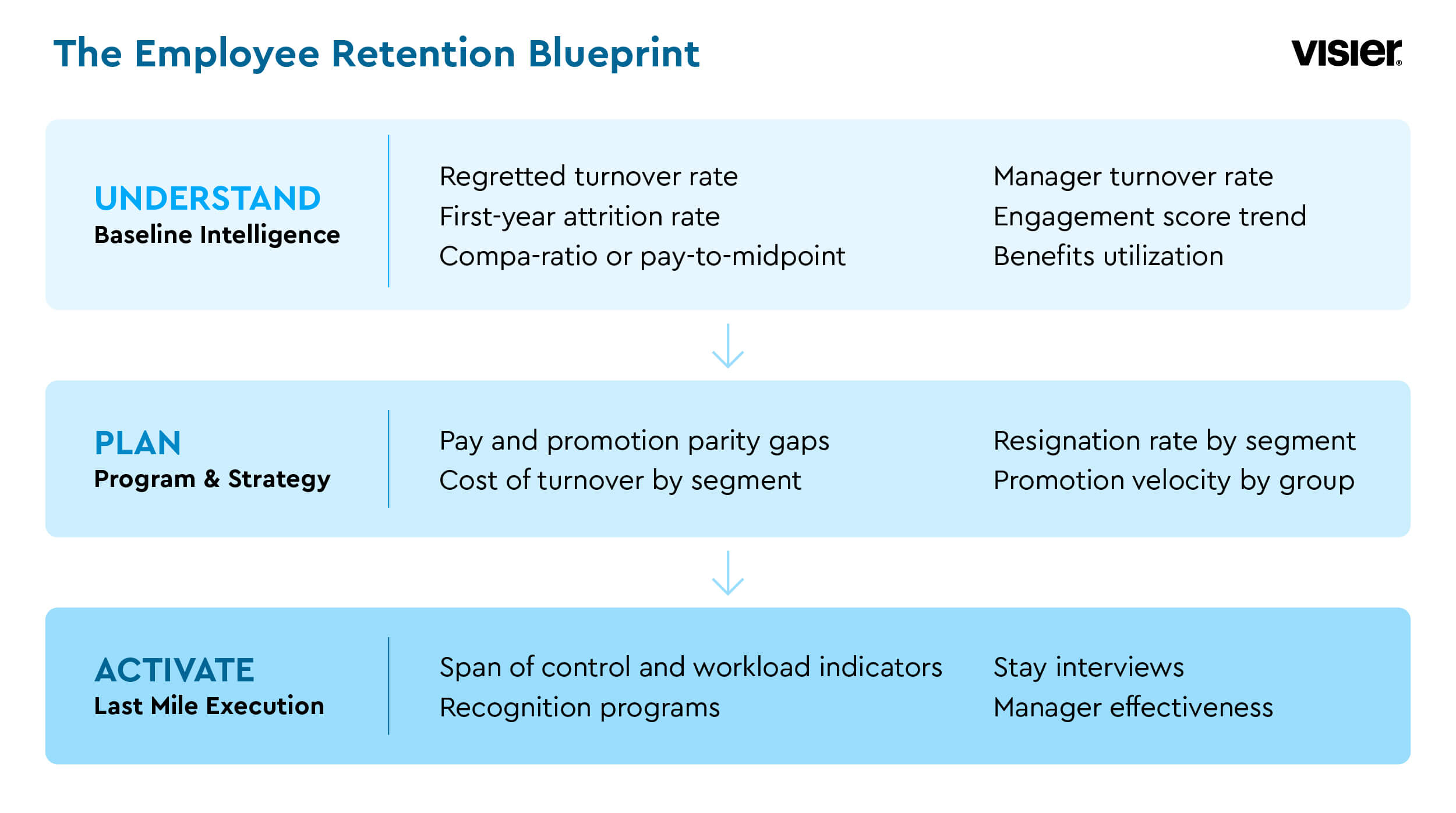
Effective retention works as a loop:
- Understand what’s happening
- Plan around the risks you discover
- Activate those plans where employees experience them
As leaders, the blueprint must connect retention programs to the workforce signals to prove what interventions are working, and what must pivot.
1. Understand: Build the baseline
You need to see where the risk is building before turnover happens, so start with a clear view of what’s influencing retention across the workforce.
Watch signals like quality of hire, compensation and equity, benefits utilization, and changes in employee behavior and sentiment over time.
2. Plan: Turn your insights into a retention strategy
Benchmark turnover reports help you understand why employees leave overall, but each company’s workforce has unique retention challenges, and you want to make sure resources go to those issues and employee groups.
For instance, you might analyze internal mobility data to see where employees’ career paths are stalling, or measure equity and parity to surface groups whose experience or outcomes differ from the rest of the workforce.
3. Activate: Make retention happen in day-to-day work
The “last mile” is giving managers timely guidance and visibility into workforce data, as well as the skills to assess workload, culture, and recognition. This is what ultimately gives them the ability to change how they distribute work and make everyday people decisions before the workforce problems you’ve uncovered turn into resignations.
13 effective employee retention strategies for retaining your best talent
The 13 retention strategies below span the full employee lifecycle, from hiring through offboarding. Each includes an example of how it works in practice.
1. Bring the right people on board
Retention starts before someone’s first day.
Culture fit is one part of this equation. Some companies, like Zappos, feel so strongly about finding the right fit—from both an employer and an employee standpoint—that they’ve offered employees $2,000 to quit if, during the onboarding process, they didn’t feel the relationship was mutually beneficial.
Equally as important are hiring people whose skills, expectations, and likely growth path fit what the role can realistically offer. Talent management can measure this by connecting quality of hire with what happens after the hire.
Combine your onboarding data with early-tenure performance and retention signals. Over time, those patterns can help you refine hiring profiles around the people who are most likely to succeed and stay.
2. Ensure competitive pay
Workers today tolerate a lot less ambiguity around pay than they used to. If someone discovers they’re underpaid, especially if they’re compressed against newer hires, chances are they’ll start looking for another, higher-paying job.
Those in charge of compensation and total rewards can work together with HRBPs to understand where pay equity frustrations are cropping up and the type of adjustments required to improve general conditions.
Providence, for example, used Visier to compare employee pay against job-grade midpoints and identify where compensation was contributing to turnover. Its resulting “pay-to-stay” strategy improved retention by 30% in key areas and saved $6 million annually.
3. Provide great benefits
SHRM’s latest research still puts healthcare, retirement, and leave at the top of employers’ priority lists, but shows flexibility and family support also playing a critical role. Today, compelling benefits packages cover employees’ physical, mental, financial, and family needs.
A compelling benefits package often now includes one or more of the following:
- Comprehensive health coverage, including mental health
- Retirement contributions
- Paid leave
- Flexible work options
- Family and caregiving support
- Health and wellness benefits
And with career development constantly mentioned as one of the highest priorities for most employees, actively funding and/or providing resources for career coaching, technical training, and professional certifications is a bonus.
Do you know whether a particular benefit is actually helping retain your employees? Compare that benefit’s utilization against turnover, retention outcomes, and exit surveys to see whether employees truly value it. With data in hand, it's possible to optimize benefits packages to move spending toward the elements that are helping people stay.
4. Develop managers to lead effectively
Effective development starts with your own workforce signals. When the data shows rising workload pressure translating into higher flight risk, managers address that specific problem immediately rather than waiting for a quarterly review to surface it.
Visier research bears out how central retention has become to this measurement. In interviews with 22 global HR leaders, 55% of organizations track employee turnover to assess whether a manager retains top talent and builds an environment people want to stay in.
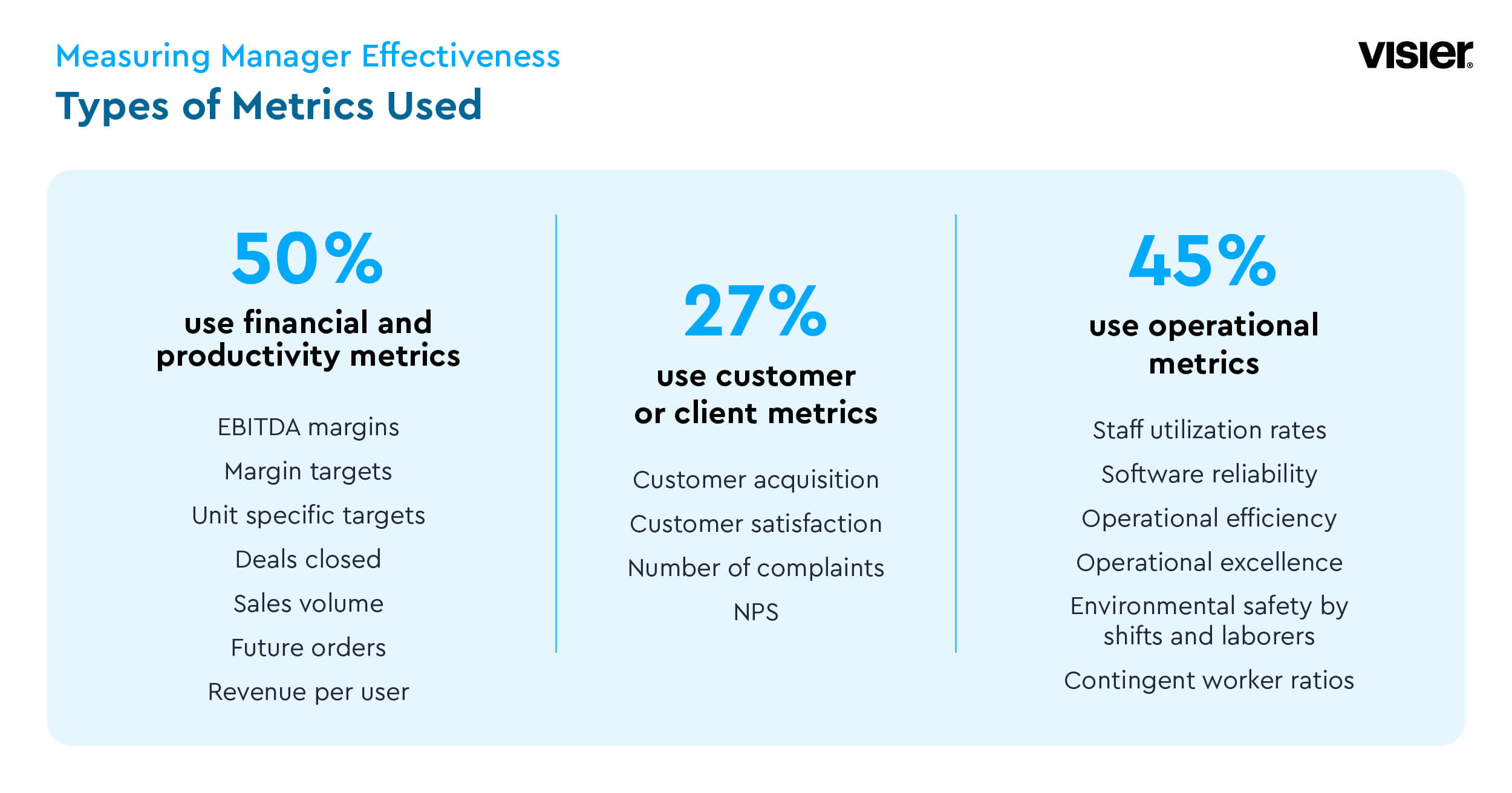
Another 65% fold engagement and culture scores into manager performance reviews. Financial and operational metrics still dominate, as the breakdown below shows, but the people metrics that predict turnover now carry real weight in how organizations judge their leaders.
Visier integrates directly within your organization’s Microsoft Teams or Slack to equip managers with the information they need to act on targeted decisions without waiting for someone else to interpret the data.

5. Create and maintain a strong company culture
Culture shows up in the small, repeated parts of work:
- Do people feel respected?
- Do managers follow through?
- Does good work get noticed?
- Do team members truly trust one another?
Individual managers are ultimately the people who shape most of this day-to-day, so it’s up to them to lead by example.
Pinpoint cultural friction by looking for team-level changes like a falling engagement rate or uneven recognition patterns across your org. Then, connect those signals to outcomes like turnover and promotions.
Enbridge, for example, uses Visier to analyze how recognition and engagement relate to turnover, performance, and promotion rates, which helps them focus their retention and employee experience efforts.
6. Offer flexibility and work-life balance
In Work Institute’s 2026 Retention Report, work-life balance accounted for 12.2% of employee departures. It specifically points to demand for flexible schedules and remote-work options and calls work-life balance a “core retention requirement” where the job allows it.
Of course, not every role can be remote or fully flexible. But when developing employee retention programs, it's worth considering whether the way roles are currently structured is sustainable.
Talent management teams can do this by analyzing workload distribution and overtime patterns across teams. If one group is consistently carrying more work or putting in longer hours, an HR business partner can flag that for managers and rebalance capacity before those employees get burnt out and, eventually, leave.
7. (Re)Focus on employee development
Upskilling, professional development, and in-company advancement opportunities keep your people from feeling like they’ve hit a ceiling within your company. These are the offers that the most ambitious team members are often looking for.
The possibilities are endless, but a few common ways to invest in professional development could include the following:
- Training, courses, and certifications tied to employees’ career goals
- Stretch assignments or cross-functional project experience
- Mentorship and coaching opportunities
- Internal moves and promotions that feel visible and attainable
8. Take the pulse of employee sentiment frequently
Pulse surveys can tell you when employees feel less engaged or less optimistic about their future. That kind of sentiment data is so much more useful when you’re also able to see what’s going on around it.
This is why operational signals matter alongside it: pay changes, promotion velocity, and manager turnover. When attitudes toward work sour in a team that recently changed managers, you have something concrete to investigate.
Yet, keep in mind that sentiment on its own simply points out a problem. It's only when sentiment is read against the operational picture that you get the detail you require to act.
Visier's employee retention solution connects the two, showing you where attrition is happening, what's driving it for any given group, and which employees are at risk, so the managers closest to those people see the signals early enough to do something about them.

9. Recognize great work, formally and informally
People want to know their efforts are both seen and valued. When recognition feels specific and earned, it makes them feel more connected to what they do.
Ideally, recognition has both a formal and informal component.
- Formal recognition gives bigger contributions and milestones a consistent structure through things like spot bonuses and companywide recognition programs.
- Informal recognition happens much more frequently: a manager calls out a specific contribution in a Slack group, a teammate thanks someone after a tough project, and so on.
Many companies overlook recognition as a retention lever because, unlike changes to a comp package or work-life balance improvements, it’s often more abstract and the payoff is less obvious.
Yet despite its more nebulous nature, its economics are hard to argue with. Recognition costs a fraction of a pay adjustment, reaches every level of the organization quickly, and, depending on the recognition, requires no budget cycle to implement. A manager who names a specific contribution in a team channel has spent nothing and changed how one person feels about their week.
The abstract nature also disappears the moment it’s measured. Engagement survey items about feeling valued, participation rates in formal recognition programs, and the gap between teams that are recognized often and teams that don’t will show up in your turnover data. Stop treating recognition as warm and fuzzy nice-to-have, and start tracking it.
10. Facilitate a respectful and healthy work environment
Employees assess their environment by whether it holds up under pressure. They want their ideas sought out and taken seriously, the freedom to raise a concern, and, at the most basic level, protection from harassment or bullying.
Meeting that standard requires more than one safe route for raising a problem. Employees who report to the person causing it need somewhere else to go, so build in options beyond the direct manager, including an anonymous channel. Pair those channels with a documented process for what happens after someone speaks up. Reporting mechanisms that lead nowhere do more damage than having none at all, because they teach employees that the organization prefers not to know.
11. Train for AI and be honest about what it changes
AI creates a difficult position for employers. You're rolling out tools many employees are still learning, while some of those same employees are secretly wondering what this means for their job security.
In Visier's 2026 poll of 1,000 US full-time employees, 32% named more AI training and upskilling opportunities as the thing that would most increase their confidence in their employer's AI approach. They also asked for greater transparency from leadership (31%), more opportunities for career advancement (24%), and clearer communication about AI's impact on employees (18%).
In this world of AI-driven workforce disruption, retain your best employees with communication and transparency about the organizations AI-roll out. You don't have to promise every role stays the same. But silence gets filled with fear, and employees are already filling it with their worst-case assumptions.
12. Design onboarding around the first-year risk window
Your onboarding checklist might end after 30 days. That doesn’t mean the employee’s fully adjusted.
Visier Workforce Intelligence lets you group new hires who share something in common (like a hire date) and ask whether the onboarding experience is actually working.
You’re then able to compare first-year retention between groups that went through different onboarding programs, measure time to productivity, and break down your results into segments (e.g., by team or location).
13. Plan for ongoing workforce restructuring
Traditionally, restructuring models account for the people who leave by design. Yet, it rarely accounts for the ones who leave afterward because their manager changed, their team doubled, or the career path they were working toward no longer exists.
Those unknowns become costly. They hit the people you meant to keep, and they arrive weeks after the reorg is announced and everyone has moved on to execution. The decision point comes earlier, when the structure is still a proposal: which teams absorb the most change, where spans of control stretch past what a manager can handle, and which groups lose the most institutional knowledge if two or three people walk.
Model those consequences while the chart is still editable. Visier's Organization Design module shows how each scenario redistributes cost, skills, and attrition risk, so you can see which version of the org you can actually staff.
Keep more of the people you can’t afford to lose.
The most effective employee retention strategies start with one thing: data. The problem is, there are too many places that data lives, which makes it hard to know what to prioritize.
Where are people leaving? Who’s most at risk? What’s different about the teams where people stay?
Visier Workforce Intelligence helps you get those answers sooner, so you can take intentional steps to address them while there’s still something to change.
See how Visier Workforce Intelligence helps you get ahead of employee turnover.

FAQ: Employee retention strategies
What are employee retention strategies?
Employee retention strategies are the policies, management practices, and workforce decisions you use to reduce unwanted turnover and keep valuable employees longer. The best ones use workforce analytics to address the reasons people are truly leaving rather than assuming someone else’s retention strategy will work for them.
How can AI improve employee retention strategies?
AI can identify turnover risks that would be difficult (if not impossible) to spot manually. It can read through thousands of data points to draw patterns across tenure, compensation, career movement, workload, and manager changes all at once. It can deliver those insights to managers instantly, so you’ll have more time to respond to the underlying issue.
Why are employee retention strategies important?
Replacing employees costs a tremendous amount of time and money, but the damage doesn’t stop with recruiting. Turnover also could mean lost institutional knowledge and disrupted teams, the downstream impact of which is heavier workloads for the people who remain.
What causes employees to leave?
There’s no one universal reason employees decide to leave. Pay and benefits, career growth, management, job fit, workload, work-life balance, and personal circumstances all play a role. If you were to ask five employees during exit interviews, you might get five different answers.
Gallup’s latest U.S. data also shows why looking beyond a single cause matters: engagement/culture and wellbeing/work-life balance collectively accounted for most reasons employees gave for leaving in 2024.
What are the costs of turnover?
Turnover creates direct costs such as recruiting, onboarding, and training a replacement, plus less-visible costs while the role is vacant and the new hire gets up to speed. You can also lose institutional knowledge, productivity, customer continuity, and capacity elsewhere on the team.
Overall, Gallup estimates that replacement costs range from about 40% of annual salary for frontline employees to 200% for managers and leaders.
How often should you run stay interviews?
There’s no magic schedule for stay interviews, but the practical baseline is every six to 12 months, with additional conversations for events like reorgs and manager changes, which could change someone’s experience.
这篇内容对你有用吗?
反馈只用于改善内容筛选,不等同于收藏